
Align structure, leadership and workforce capacity with business priorities.
HR CHAMP helps growing SMEs and mid-market organizations clarify executive reporting lines, authority boundaries, and headcount forecasts so the organization can operate effectively as the business evolves.

For organizations where execution speed is constrained by leadership coordination, governance alignment, and decision flow.
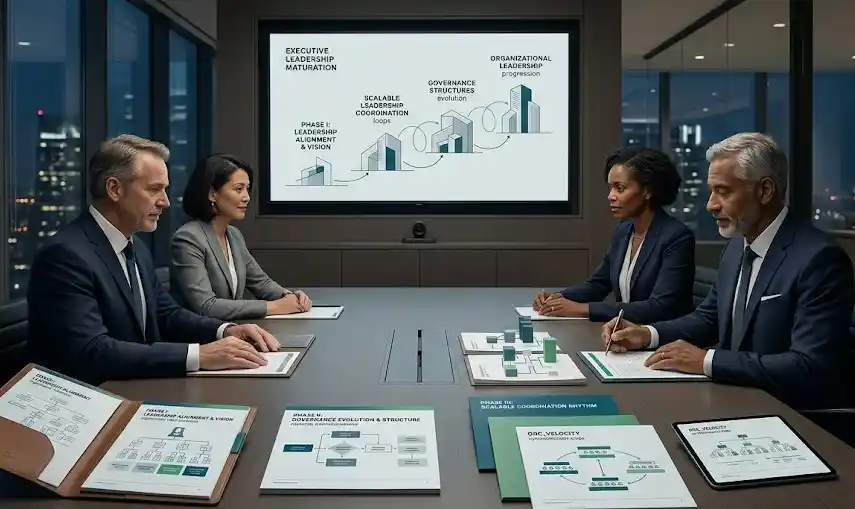
Leadership Architecture determines how effectively organizations sustain coordination, decision velocity, and operational performance as complexity increases.
HR CHAMP architects the leadership capability, governance alignment, and organizational coordination required to maintain execution consistency as companies scale.
We replace informal leadership structures with a defined Leadership Architecture: the governance, accountability, and decision layer required for high-velocity organizational execution.
Outcome:
Faster decisions, stronger alignment, and more consistent roadmap delivery.
As businesses grow, restructure, or expand cross-border, informal management setups create structural friction. We address five core structural failure points:
Responsibilities overlap across departments, creating duplicated effort and missed operational handoffs.
Routine operational approvals consistently escalate to founders and C-suite executives, stalling execution..
Reporting lines reflect historical legacy setups rather than current strategic business priorities.
Mid-level management lacks a defined span of control, boundaries, and performance metrics.
Headcount additions are reactive, causing labor costs to outpace business output.
Between 20 and 100+ employees, execution begins to slow—not due to product limitations, but due to leadership constraints.
Without structured leadership architecture, organizations accumulate Scaling Debt—hidden inefficiencies that reduce velocity and impact execution.
Promoting high performers into leadership without structure or governance.
Communication friction and delayed decision cycles reducing execution speed across teams.
Leadership capability failing to evolve alongside operational and technical complexity.
Leadership development treated as optional rather than operational infrastructure.
These constraints compound over time, reducing execution velocity and increasing organizational drag.
Redesigning reporting lines, management layers, and organizational relationships.
Deploying RACI frameworks, delegation protocols, and clear authority levels across leadership tiers
Structuring executive interfaces and management capacity.
Aligning headcount forecasts, skill requirements, and labor budgets with revenue goals.
Reorganizing workforce structures during acquisitions, market pivots, or cost-realignment phases to protect core operational delivery.
From Leadership Friction to Leadership Alignment.
Impact: Visibility on where decisions and accountability are breaking down.
Impact: Improved decision flow
Impact: Stable execution, built to hold through growth, pressure, and change.
Assess the current structure, roles, leadership capacity, and workforce requirements.
Define the structure, responsibilities, decision rights, and workforce priorities needed.
Support leaders and managers in putting the agreed changes into practice.
Evaluate effectiveness, identify gaps, and refine the structure as needs evolve.
Clear ownership of roles and decisions, with faster cycles through delegated authority to qualified mid-level managers..
C-suite focus shifts from micromanagement to strategic decisions.
Headcount planning and talent budgets mapped directly to business milestones.
Unstructured leadership creates compounding execution inefficiencies:
This is not a leadership issue—it is a capital efficiency constraint impacting execution.

HR CHAMP aligns leadership capability development with organizational complexity and execution intensity to ensure measurable operational ROI.
Engagement is calibrated based on:
This ensures leadership capability scales with your business—not behind it.
HR CHAMP supported us in recruiting a critical management role with professionalism, persistence, and thoughtful guidance throughout the process.
Nada’s strategic advice and commitment to quality made the experience both smooth and effective
VP Operations, MF Global, Croatia, Europe
Fast and reliable IT recruitment and HR solutions!
HR Champ filled key positions in just 4 weeks, leading to increased production efficiency.
I highly recommend their services!
Hala Kaawar
Operations and Process Improvement Coordinator, Coders, Beirut, Lebanon
An organization should review its structure when revenue growth plateaus despite added headcount, routine operational decisions stall at the C-suite level, or during major strategic shifts such as cross-border expansion, M&A integration, or market restructuring.
Organizational design is the architecture of the business — reporting lines, decision rights, authority levels, and role definitions.
Workforce planning is capacity and capability — forecasting the headcount, skills, and labor costs required to achieve business goals.
Yes. We support leadership teams through restructuring during growth transitions or cost realignments, ensuring structural clarity, team realignment, and minimal operational disruption.
Workforce planning replaces reactive hiring. It identifies critical talent gaps, predicts future skill shortages, and aligns recruitment schedules directly with revenue timelines and budget constraints.
Once your organizational structure and decision rights are established, ensure your daily policies match through our People Operations & Governance frameworks.
Explore Related Capabilities:
Identify where leadership is limiting execution in under 60 seconds..
"*" Indicates Required Fields
Developed by Freelancerleb
Copyright © 2021. All rights reserved.